Reliable Heating & Air Conditioning Expert in Cary, Chapel Hill & Morrisville with 25 years of experience

Vented vs Ventless Gas Logs in North Carolina: Which Is Right for Your Home?

When a homeowner in Raleigh or Cary calls us about adding gas logs to an existing fireplace, the first question our team asks is not about brands, sizes, or remotes. It is this: “Do you have a working flue and damper?”

The answer determines almost everything that follows: whether vented or ventless gas logs are even an option, how much heat you will get, what the flame will look like, what North Carolina’s building code will allow in that room, and whether a permit is needed. After 25 years of installing gas log sets in Wake County homes, we know that homeowners who understand this decision before they shop end up happier with the fireplace they get.

What Are Vented Gas Logs?

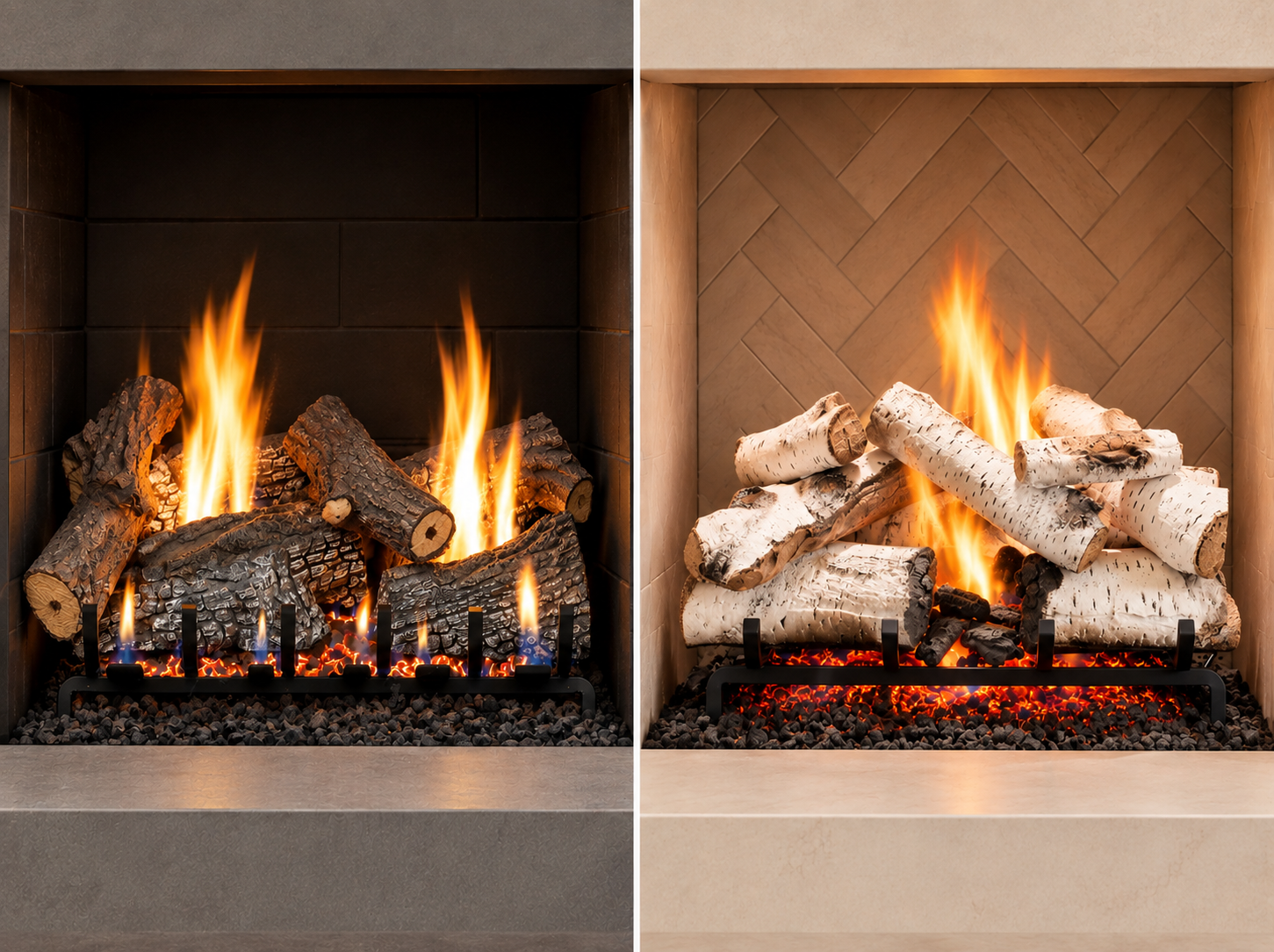
Vented gas logs are designed to burn in a fireplace that was built for wood: a masonry firebox with a chimney, a flue, and a damper. The log set sits on a burner pan in the firebox, and it burns exactly the way a wood fire does, with the damper open and the products of combustion going up the chimney.

Because the flue carries the exhaust away, the burner can be tuned for looks rather than for clean combustion. That is why vented logs have the tall, yellow, dancing flame people picture when they think of a fireplace. The better sets, with hand-painted logs, glowing ember beds, and multi-burner “stadium” layouts, are difficult to tell from wood at a glance.

The trade-off is heat. Most of the warmth from a vented set goes up the chimney with the exhaust, just as with a wood fire. You will feel radiant heat sitting near it, but a vented log set is an ambience appliance first and a heater second.

Two more things follow from the open damper. North Carolina’s code requires the damper to be permanently fixed open (or removed) when vented logs are installed, so it can never be closed on a burning set; we fit a damper clamp on every vented job. And because the flue is in use, the chimney must be sound. A cracked liner or blocked flue rules out vented logs until it is repaired.

Best for: existing masonry fireplaces with a working flue, and anyone whose priority is the look of a real fire.

Most common in: the established Cary neighbourhoods built from the 1960s through the 1990s, such as MacGregor Downs, Preston, Lochmere, and Kildaire Farms, and the older Raleigh neighbourhoods inside the Beltline and around North Ridge, where homes came with masonry wood-burning fireplaces.

What Are Ventless Gas Logs?

Ventless (also called vent-free or unvented) gas logs burn with the damper closed, or in a firebox with no flue at all. The burner is engineered to burn the gas almost completely, so that the small quantity of combustion by-products it produces is considered safe to release into the room in a properly sized space.

The consequence is heat. Because nothing goes up a chimney, nearly all the energy in the gas ends up in the room. A ventless set will noticeably warm a family room in a way a vented set will not, many are sold with thermostatic remotes for that reason, and they cost less to run.

The trade-offs are real. The flame is smaller, bluer, and less realistic, because it is tuned for clean combustion rather than appearance. Ventless sets release water vapour into the room, which some homeowners notice as condensation on windows, and most people can detect a faint odour when the set is running. Every ventless set carries an oxygen depletion sensor (ODS) that shuts the gas off if room oxygen falls below a safe level, and that sensor needs to be kept clean or the set will nuisance-trip.

And in North Carolina, ventless gas logs come with rules that vented ones do not.

NC Building Code Rules for Ventless Gas Logs

North Carolina does allow ventless gas appliances, unlike California and a small number of other states that ban them outright. But the North Carolina Residential Code (in its fuel gas chapter, under unvented room heaters) places specific limits on where they can go and how large they can be. These are the ones that come up on almost every Wake County job.

Because North Carolina’s building code is statewide, these rules do not change between Cary, Raleigh, Apex, or unincorporated Wake County. What does vary is the permitting. Installing a gas appliance and running or modifying gas piping requires a permit and inspection in most cases, issued by the Town of Cary, the City of Raleigh, or Wake County depending on your address. Homeowners’ associations and multi-family building rules can add restrictions of their own, particularly on ventless units. Our licensed gas technicians (NC State License No 37063) handle the permit and tell you at quote time whether an inspection will add a second visit.

This is the part of the decision where we earn our keep. Every home is different, and we will tell you plainly which type is correct for your fireplace, your room, and your code situation before you spend anything.

Which Is More Common in Wake County?

Vented, by a clear margin, and the reason is housing stock. Most homes across Cary and Raleigh built from the 1970s through the early 2000s came with a masonry wood-burning fireplace that already has a working flue. When those homeowners tire of hauling wood, a vented set is the natural conversion: no room-size restrictions, the most realistic flame, and no change to the way the fireplace breathes.

In Preston, MacGregor Downs, and Lochmere in Cary, and North Ridge and the Five Points area in Raleigh, we install vented sets in the large majority of masonry fireplaces we convert. The exceptions are homes where the chimney has a problem the owner does not want to fix, or where a north-facing family room is cold and the owner wants heat more than looks.

In newer construction, in Cary Park, Amberly, Wakefield, and the subdivisions around Holly Springs and Wake Forest built since the mid-2000s, it varies with the fireplace type. Many of these homes already have a factory-built direct-vent gas fireplace, which takes neither kind of log set; it has its own sealed log arrangement. Those with a prefabricated wood-burning fireplace can usually take a vented set, and a ventless set only if the unit is listed for it.

The Installation Process

Most gas log installations, vented or ventless, are completed in a single visit of two to four hours. Here is what that visit involves and where the two types differ.

The Brands We Install

We stock and install three lines and can source most others.

Real Fyre by R.H. Peterson has been making gas logs in the United States since the 1940s and is the benchmark for realistic vented sets: hand-painted ceramic refractory logs cast from real wood, ember beds that glow, and a wide range of burner systems from match-light to fully remote. They also make a well-regarded vent-free line.

Grand Canyon Gas Logs is an American manufacturer known for extreme realism and large-format sets. Their logs are cast from actual timber found in the Southwest, and their multi-burner configurations produce the tallest, most wood-like flames in the vented category. They are the set we recommend most often when appearance is the priority.

Majestic is part of the Hearth & Home Technologies family and offers dependable vented and vent-free log sets that pair well with the many Majestic fireplaces already installed in Triangle homes. They are a strong value choice.

Gas Log Repair

We repair the same brands we install, along with most sets sold in the Triangle over the last 30 years. The calls we take from October to February follow a familiar pattern: a set that will not light, a pilot that keeps going out, a lazy yellow flame with soot on the logs, a remote that has stopped responding, or logs that have shifted or cracked. Most of these come down to a pilot orifice, a thermocouple, a receiver, or log placement, and most are fixed the same day from parts on the van. If your set will not light, our gas fireplace troubleshooting guide covers the checks that apply to log sets too.

Book a Free Estimate

Whether you are converting a wood-burning fireplace in Preston or replacing a tired set in a Wakefield family room, the right first step is a free estimate. Send us a photo of the fireplace and its width, depth, and height, or book a visit, and we will tell you which type fits your home and room, which sets we would put in our own house, and an upfront, flat-rate price in writing.

Read more about the sets and options on our gas logs page; if you want an existing set cleaned and checked before the season, our annual tune-up covers gas logs as well as fireplaces. Call our Cary office at (919) 762-6267 or our Knightdale office at (919) 899-4220 for Raleigh and points east, or book online below. Our licensed gas technicians have installed gas logs across Wake County for more than 25 years and hold a 4.9-star rating across 230+ Google reviews.

Get a Free Gas Log Estimate in Cary or Raleigh

Send us a photo and your firebox dimensions, or book a visit. We will tell you plainly which type fits your home and quote a flat-rate price in writing. Cary (919) 762-6267 · Knightdale (919) 899-4220.
Gas Fireplace Cleaning Cost in Raleigh & Cary NC — What to Expect in 2026

If you have typed “gas fireplace cleaning cost” or “fireplace cleaning near me” into Google, you want a number, and you have probably found that most companies either will not give one or give one that turns out to be a starting point. We are not going to print a price in this article either, because our prices are flat-rate and quoted live so they are always current, and a number on a web page is out of date the day it is written. What we will do is give you a clear framework: what moves the cost up or down, exactly what a proper cleaning includes, how to tell whether you need a cleaning, a tune-up, or a repair, and what a fair company should promise before you book.

The one thing we can say about price without qualification: with us, what you are quoted is what you pay. No hourly meter, no add-ons discovered on the day.

What Affects the Cost of Gas Fireplace Cleaning in NC

Four things determine what a cleaning visit costs in the Raleigh and Cary area.

1. Type of unit: millivolt or IPI

A millivolt (standing pilot) fireplace, which is what most homes built in the 1990s and 2000s in Preston, Lochmere, North Ridge, or Kildaire Farms have, is mechanically simple. The pilot assembly comes apart predictably and the cleaning is quick.

An IPI (intermittent pilot ignition) fireplace, typical of newer construction in Amberly, Cary Park, and Wakefield, has an electronic module, a flame-sensing rod, and a battery backup pack that all need to be checked and cleaned alongside the pilot and burner. There is more to do, and more that can be found wanting.

Vent-free (ventless) log sets with an oxygen depletion sensor sit somewhere in between: simple hardware, but the ODS pilot must be cleaned carefully or the set will nuisance-trip all winter.

2. Access and age

A fireplace with a lower louver that opens and a glass front held by four clips is a straightforward job. One built into custom cabinetry, a glass frame painted or caulked shut by a previous owner, or a 30-year-old insert with brittle fittings all take longer. Age also affects what we find: a fireplace that has never been cleaned needs a first-time deep clean that one serviced every year does not.

3. Standalone cleaning or part of an annual tune-up

This is the biggest factor. A cleaning on its own addresses appearance and flame quality. A tune-up includes that same cleaning plus the safety work: thermocouple testing, gas leak testing, gasket and venting inspection, and a carbon monoxide reading with a combustion analyser. Because the technician is already there with the glass off and the pilot apart, the incremental cost of the safety inspection is small compared with booking it separately. It is why we recommend the combined visit and why most of our Wake County customers choose it.

4. Parts found during the inspection

A cleaning is not a repair, but a good cleaning frequently finds the reason your fireplace has been behaving oddly. A thermocouple reading low, a gasket that has hardened, an igniter that is weak. These are quoted separately, flat-rate, and installed only with your approval. Our vans carry the common ones, so if you say yes, it is done the same visit.

What Is Included in a Gas Fireplace Cleaning

From the homeowner’s side, here is what a thorough gas fireplace cleaning in Raleigh or Cary should leave you with. If a company’s cleaning does not cover all five, ask what you are paying for.

Every cleaning we do also includes a wipe-down of the interior firebox and a check of the remote or wall switch, and because we are a licensed gas contractor (NC State License No 37063), a carbon monoxide reading before we leave, regardless of which service you booked.

Cleaning vs Tune-Up vs Repair

Homeowners often book the wrong thing, which wastes their time and ours. Use this to work out which one you need.

Start here: is the fireplace working?

  • Yes, it works, but the glass is hazy, the logs look grey, or the flame looks lazier and yellower than it used to. You need a cleaning. If it has also been more than a year since anyone tested the safety components, book the tune-up instead and get both in one visit.
  • Yes, it works, and it looks fine, but it has not been serviced in a year or more (or has not been used since spring). You need a tune-up. Cleaning is included; the point of the visit is the safety inspection.
  • No, it will not light, the pilot will not stay lit, it clicks without lighting, or it shuts itself off after a few minutes. You need a repair diagnostic. The technician will still clean whatever needs cleaning, but the visit is priced and scheduled as a repair because a part has probably failed. Our won’t-light troubleshooting guide can help you narrow it down before you call.
  • You smell gas, see soot building up quickly, or a carbon monoxide alarm has sounded. Stop using the fireplace and call for a repair today. If you smell gas, leave the home and call from outside.

Is Gas Fireplace Cleaning Worth It?

Consider what the alternative costs.

A fireplace that goes uncleaned does not stay the same; it deteriorates. Clogged burner ports and shifted logs produce incomplete combustion, which produces soot and carbon monoxide. A pilot assembly that is never cleared eventually cannot heat the thermocouple properly, and a thermocouple that runs marginal for years is how a fireplace ends up needing a gas valve. A glass gasket that is never inspected fails, and a direct-vent unit run with a failed seal soots itself within a week.

Against that, an annual cleaning is a modest, predictable, flat-rate cost. Across more than 25 years in Wake County, it has prevented the large majority of October emergency calls we would otherwise take, and the emergency call is always more expensive than the appointment that would have prevented it, before you count the evenings without a fireplace while you wait for a slot. Annual cleaning is worth it the way changing the oil is worth it.

What to Expect From GreenergyAir

When you book a gas fireplace cleaning with us in Raleigh, Cary, or anywhere in Wake County, here is what you can hold us to:

  • Flat-rate pricing, quoted before you book. Call either office and you will have an exact price in under a minute. That price does not change when the technician arrives.
  • No surprises on the invoice. Anything found during the visit is explained in plain language and quoted separately before any work is done.
  • A licensed gas technician, not a generalist. Every technician works under NC State License No 37063, and every visit ends with a carbon monoxide reading.
  • Two Wake County offices. Cary, at 15000 Weston Pkwy Suite 131, serves Cary, Apex, Morrisville, Chapel Hill, and Holly Springs. Knightdale, at 5321 Fox Pointe Dr, serves Raleigh, Wake Forest, Garner, Knightdale, Wendell, and Zebulon. Same standards, same price, whichever office comes to you.
  • A 4.9-star record across 230+ Google reviews that you can read for yourself before you call.

For most homeowners the right booking is the combined tune-up and cleaning, and September is the month to do it, before the October rush fills the calendar. You can see everything else we do on our fireplace services page.

Get a Flat-Rate Price in Under a Minute

Call either office for an exact quote, or book the combined tune-up and cleaning online. What you are quoted is what you pay. Cary (919) 762-6267 · Knightdale (919) 899-4220.

Why Gas Fireplaces Fail Every October in North Carolina (And What to Do Before the First Cold Night)

Our team answers more “my fireplace won’t work” calls in October than in any other month of the year, and it is not close. The pattern is so reliable that we staff for it. The first week the overnight temperature drops into the 40s, the phones light up from Apex to Wake Forest, and the fireplaces on the other end of the line have almost all failed for the same handful of reasons.

The cause is not October. The cause is the six months before it. A North Carolina summer does specific, predictable things to a gas fireplace that sits unused through it, and once you understand what those things are, you can prevent nearly all of them with a single appointment in September. Here is the pattern we see every year and exactly what drives it.

The NC Summer Problem

Between June and August, Wake County typically sits at 90 to 100 degrees in the afternoon with relative humidity between 70 and 85 percent. Dew points in the 70s are routine. Your fireplace spends that entire stretch switched off, with no airflow through the firebox and no heat cycling through its components, in a house that is often cooler and drier than the crawlspace or exterior wall the fireplace backs onto.

That environment works on four parts of the fireplace at once.

The pilot assembly becomes a sheltered, still, dark cavity for insects, and the tiny pilot orifice is exactly the size of opening that a spider web or an egg sac can block completely.

The thermocouple or thermopile, which spent the winter cycling from cold to red-hot several times a day, now sits idle. Idle is not restful for these parts. Moisture and the fine residue left from last season’s combustion settle on the probe and the pilot hood, and the probe’s output, already declining a little each year, can drop below the threshold that holds the gas valve open.

The glass gasket on a direct-vent unit is a fibre or rubber seal that stays supple through use and hardens when it is not heated for months. A gasket that has shrunk or cracked over summer breaks the sealed combustion system, and the fireplace will either refuse to hold a flame or soot the glass within days.

The burner ports collect whatever the summer brings: dust from the house, pet hair, fragments of ember material, and occasionally the debris of a wasp or mud dauber that found its way in through the vent. Blocked ports produce an uneven, lifting, or lazy yellow flame the first time you light the fireplace.

The Spider Web Problem

We are going to name this one directly, because if you have owned a gas fireplace in Cary or Raleigh for more than a couple of years, you have probably already been told about it, and if you have not, it is the single most useful thing you can learn from this article.

Spiders like the pilot assembly of a gas fireplace. It is dark, it is protected, it does not move for six months, and there is a long-standing belief in the trade that the odourant added to natural gas attracts certain species. Whether or not that last part is true, the result is not in dispute: when our technicians pull the pilot assembly on an October service call in Wake County, a web across the pilot orifice is what we find more often than any other fault.

The pilot orifice is a precision-drilled hole roughly the diameter of a sewing needle. It only takes a single strand of silk, or the dusty residue of a web that was there in August, to reduce gas flow at the pilot enough that it either will not light or lights with a small, weak flame that cannot heat the thermocouple to its holding voltage. From your side of the glass, the fireplace clicks and does nothing, or the pilot catches and dies when you release the knob, and it looks exactly like a failed igniter or a dead valve.

We see it in every kind of home, but we see it most in the established Cary neighbourhoods, in Preston, Lochmere, MacGregor Downs, and the older sections of Cary Park, where the fireplaces are original to homes built from the late 1980s through the early 2000s. Those units have standing pilots, more open lower cavities, and twenty-plus seasons of fine residue for a web to bind to. Newer sealed direct-vent units in Amberly or Wakefield are less exposed but by no means immune; we clear webs from IPI pilot hoods every autumn too.

The fix is not something you can do from the outside. Compressed air blown at the burner does not reach the orifice. The pilot assembly has to be removed, the orifice cleared with the correct tool (a wire enlarges the hole and permanently changes the flame), the hood and the thermocouple cleaned, and everything reset to the proper position. Done in September as part of an annual tune-up, it takes fifteen minutes. Done in late October, it takes fifteen minutes plus however long you waited for an appointment.

The Four Things That Fail After a NC Summer

If we sorted a typical October’s worth of won’t-light calls by cause, the list would look like this.

Notice what is not on this list. Gas valves fail, but rarely in October specifically, and they are usually the end result of years of a pilot that was never quite right. Bird and wasp nests in the exterior vent cap are real and we clear them every year, but they trail the four above by a wide margin.

The Prevention Checklist

Here is the honest version of what a homeowner can and should do before the first cold night, and what genuinely requires a professional.

What you can do yourself

  • Replace the batteries. Both sets: the handheld remote or wall thermostat, and the receiver box behind the lower louver, which usually holds four AA batteries. If you have an IPI system with a battery backup pack, replace those too. Check that the receiver’s slide switch is on REMOTE.

That is genuinely the whole list. It is worth doing, because dead batteries account for a share of every October’s calls, and it costs a few dollars.

What requires a professional

Everything else on this page. Specifically:

  • Removing and cleaning the pilot assembly and clearing the orifice.
  • Testing the thermocouple or thermopile with a meter and replacing it if it is below spec.
  • Inspecting and replacing the glass gasket, and re-seating the glass on a direct-vent unit.
  • Testing the ignition module for spark and flame sensing.
  • Clearing and cleaning the burner ports and resetting the log set to the manufacturer’s diagram.
  • Inspecting the termination cap and vent run.
  • Leak-testing every gas fitting and measuring carbon monoxide with a combustion analyser.

All of that is one appointment. It is what a gas fireplace tune-up is, and if the visit turns up a part that has already failed, it becomes a same-visit repair with a flat-rate price you approve first. If your fireplace has already stopped working and you want to narrow down the cause before you call, our nine-point troubleshooting guide covers what to check.

Book Before October

We have written this article in September for a reason. Right now, same-day and next-day appointments are available across Cary, Raleigh, and the rest of Wake County. In three to four weeks they will not be. A tune-up booked today means your fireplace lights on the first cold night, and it means the technician who comes to your home is doing a scheduled visit rather than working through a backlog of emergency calls.

Our licensed gas technicians (NC State License No 37063) have been servicing gas fireplaces in the Triangle for more than 25 years, our pricing is flat-rate and quoted before you book, and 230+ Google reviews at 4.9 stars are the record we work to keep. Book online in two minutes below, or call our Cary office at (919) 762-6267 or our Knightdale office at (919) 899-4220 for Raleigh and points east. You can also browse the full range of fireplace services we offer across Wake County.

Beat the October Rush — Book Your Tune-Up Now

Same-day and next-day slots still available across Cary and Raleigh in September. Licensed gas technicians, flat-rate pricing, 4.9 stars on 230+ reviews. Cary (919) 762-6267 · Knightdale (919) 899-4220.
How Often Should You Service Your Gas Fireplace? (The Answer for NC Homeowners)

The short answer: once a year, every year, and in North Carolina the month to do it is September.

The longer answer is the rest of this article. Why annual and not “when it acts up,” why September specifically rather than whenever the first cold snap reminds you, what actually happens when you skip a year, and what you should expect to get for your money when a technician spends an hour with your fireplace. Our team has serviced gas fireplaces across Wake County for more than 25 years, and this is the maintenance schedule we would follow in our own homes.

Why Annual Service Matters for Gas Fireplaces

A gas fireplace is a gas appliance that burns an open flame in your living room. It deserves the same respect as your furnace, and every major manufacturer, from Heat & Glo and Napoleon to Majestic and Empire, specifies annual professional service in the owner’s manual. Many warranties depend on it.

Three things happen to a gas fireplace between one season and the next, none of which you can see from the sofa.

First, combustion residue builds up. Even a clean-burning fireplace deposits a fine film on the burner ports, the pilot hood, the log set, and the inside of the glass. Over one season it is harmless. Over several it changes the flame pattern, and a changed flame pattern means incomplete combustion.

Second, safety components drift out of spec. The thermocouple or thermopile that holds your gas valve open weakens a little every year. Gaskets harden. Flame sensors on electronic ignition systems pick up a coating that makes them unreliable. Each of these fails gradually, then all at once, and “all at once” is always a cold night.

Third, the venting changes without you knowing. Termination caps collect nests. Vent runs shift. Damper clamps on vented log sets loosen. None of these announce themselves, and every one of them affects whether the products of combustion, including carbon monoxide, go where they are supposed to go.

An annual gas fireplace maintenance visit catches all three while they are ten-minute fixes. That is the entire argument for it.

Why September Specifically?

If you are searching for gas fireplace maintenance near me in Raleigh or Cary, the answer to “when” is at least as important as “who,” and here it is local knowledge that matters.

The NC summer is the problem. From June through August, Wake County runs 90 to 100 degrees with humidity between 70 and 85 percent. Your fireplace sits idle through all of it. That combination of heat, moisture, and stillness is what dries out gaskets, corrodes battery contacts in remote receivers and ignition modules, and, most famously, invites spiders to web the pilot orifice. By Labor Day, whatever damage the summer was going to do is done. A September service finds it and fixes it before you ever try to light the fireplace.

October is when everyone calls at once. The first night the temperature drops into the 40s, which in the Triangle is typically the second or third week of October, every fireplace owner in Wake County reaches for the remote on the same evening. The ones whose fireplaces do not light all call the next morning. Our schedule, and every reputable fireplace company’s schedule, fills within days and stays full into November. A tune-up booked in September gets you a convenient slot and a relaxed technician. A repair call in late October gets you a place in the queue.

September is also when you can still choose a good day. Same-day and next-day appointments are common in September. That is not true a month later.

What Happens If You Skip Annual Service?

We are not going to pretend the fireplace explodes. Most of the time, skipping a year means nothing obvious happens, which is exactly why people skip two, then three. Here is what is actually going on when service is deferred:

What Does a Gas Fireplace Service Include?

Our gas fireplace tune-up and cleaning follows a 12-point checklist on every visit. Rather than list what we do, here is what you get from each part of it as the homeowner:

If the visit turns up something larger, such as a gas valve or a damaged vent, that is a gas fireplace repair, quoted separately and never started without your approval.

How Much Does Annual Gas Fireplace Service Cost in NC?

We charge flat-rate pricing. You get an exact price when you call, that price includes the cleaning, the 12-point inspection, the carbon monoxide test, and the written report, and it does not change when the technician arrives. Parts, if any are needed, are quoted separately and approved by you before they are installed.

We deliberately do not publish a number here because it would be out of date the next time our costs changed, and we would rather you call and get the real figure than read a stale one. Call (919) 762-6267 (Cary) or (919) 899-4220 (Knightdale) and we will quote it in under a minute. If you would prefer not to think about it every year, our annual fireplace maintenance plan bundles the tune-up into one fixed rate with priority September scheduling and a reminder from us.

How to Book Before October Slots Fill

Every September we say the same thing, and every October we are proven right: the homeowners who book in September get the slot they want, and the ones who wait join the queue.

Booking takes two minutes. Use the online booking link below to pick a day and time that suits you, or call either office. If your fireplace has not been used since spring, tell us; if it has not been serviced in more than a year, tell us that too, so we allow the right amount of time. Our licensed gas technicians (NC State License No 37063) serve all of Wake County and the wider Triangle from our Cary and Knightdale offices, and 230+ Google reviews at 4.9 stars say they do it well.

Book Your September Tune-Up Before October Fills Up

Cleaning, 12-point tune-up, CO test and written safety report in one visit. Flat-rate price quoted before you book. Cary (919) 762-6267 · Knightdale (919) 899-4220.

Gas Fireplace Won’t Light or Not Working? 9 Things to Check (and When to Call a Pro)

It is the first cold night of October. You reach for the remote, flip the wall switch, or turn the knob on the gas fireplace for the first time since March. Nothing happens. Maybe a click. Maybe a pilot that catches and dies the moment you let go of the knob. Maybe nothing at all.

This is the single most common call our team takes every October, from Preston and Lochmere in Cary out to Wakefield and Wake Forest, and after 25 years of answering it we can tell you the good news up front: a gas fireplace that won’t light after summer is usually not broken. In most cases it is one of nine things, and several of them you can check yourself in ten minutes. Here is the gas fireplace troubleshooting list our technicians work through, in order, with a clear line drawn where a licensed gas technician should take over.

Safety first: if you smell gas at any point, stop reading, leave the home, and call us from outside.

Safety First: When to Stop and Call Immediately

Two rules before any troubleshooting.

If you smell gas (the rotten-egg odour is added to natural gas and propane precisely so you notice it), do not flip light switches, do not use the phone inside, do not try the igniter “one more time.” Leave the house, leave the door open behind you, and call us from the driveway at (919) 762-6267 or (919) 899-4220. A faint whiff for a second when a pilot first lights is normal. A smell that lingers, or a smell with the fireplace off, is not.

If your carbon monoxide alarm sounds while the fireplace is running, turn it off, open windows, get everyone outside and call. Do not use it again until it has been inspected. Everything below assumes neither of those is happening.

9 Things to Check When Your Gas Fireplace Won’t Light

The first five take a few minutes and a flashlight. The last four are about knowing what you are looking at so you can describe it accurately when you call.

1. Check the Pilot Light

Open the lower louver or access panel below the firebox and look for a small blue flame near the burner. Whether you should see one depends on the type of system you have.

A standing pilot (millivolt) system keeps a small flame lit around the clock. Many homeowners in Wake County turn the pilot off in April to save gas and then forget they did it. If the pilot is out and you have a knob marked OFF / PILOT / ON, you can relight it: turn the knob to PILOT, push it in and hold, press the red or black igniter button until the pilot catches, then keep the knob held in for a full 30 to 60 seconds before releasing it. If it lights but dies when you let go, wait five minutes and try once more. If it dies a second time, stop; that is a thermocouple problem (item 2), not a technique problem.

An IPI (intermittent pilot ignition) system has no standing pilot at all. It sparks the pilot electronically each time you turn the fireplace on. If your fireplace has no OFF / PILOT / ON knob and you hear clicking when you try to light it, skip to item 3.

2. Check the Thermocouple or Thermopile

These are the two small metal probes sitting in the pilot flame, and they are the most common reason a pilot lights but will not stay lit.

A thermocouple generates a tiny electrical current when heated by the pilot flame, and that current holds the gas valve’s safety magnet open. If the pilot goes out, the current stops and the valve closes: the safety feature working as designed. The problem is that thermocouples degrade. A healthy one produces roughly 25 to 30 millivolts; once it drops below about 15 to 18, the valve will not stay open and the pilot dies the moment you release the knob.

A thermopile is the larger cousin that powers the main burner valve on millivolt systems. Healthy output is 500 to 750 millivolts with the fireplace off. When it falls much below 300 under load, the pilot stays lit but the main burner will not come on when you flip the switch, a different symptom worth mentioning when you call.

A dirty pilot flame that no longer wraps the probe produces the same symptom as a failed probe, which is why we clean the pilot assembly before we condemn a thermocouple. Testing either one needs a multimeter at the valve terminals. Replacement is quick, and our vans carry them.

3. Check the IPI Ignition Module

If you hear click-click-click and see a spark but no flame, you almost certainly have an IPI system and the module is trying to do its job. Three things cause clicking with no flame:

  • No gas is reaching the pilot hood. Usually a blocked pilot orifice (see item 6) or a closed valve (item 4).
  • The flame sensor is dirty. IPI systems confirm the pilot is lit through a process called flame rectification, using a small rod next to the pilot. If the rod is coated after a humid summer, the module cannot “see” the flame, so it keeps sparking and then locks out even though the pilot briefly caught. You will sometimes see the pilot light for a few seconds and then shut off.
  • The module itself, or its power supply, has failed. Many IPI modules run on a wall transformer with a battery backup pack (usually four AA batteries) behind the lower louver. A backup pack full of leaked, corroded batteries after a hot summer is something we see constantly.

If you get no click at all on an IPI unit, check item 5 first.

4. Check the Gas Valve

There are two valves to think about. The manual shutoff is the one you can check. In most Wake County homes it is either a key valve set into the floor or wall within a few feet of the fireplace (the removable key is often on the mantel or in a kitchen drawer), or a quarter-turn ball valve behind the lower louver. A handle parallel to the pipe is open; perpendicular is closed. It is remarkably common for a shutoff to have been closed during a home sale, a renovation, or a spring clean and never reopened.

The appliance gas valve inside the unit is not something to adjust. If the shutoff is open, the pilot is lit, and the main burner still does not fire, the appliance valve or its control circuit may have failed. Diagnosing that is professional work.

5. Check Remote Control and Wall Switch Batteries

This is the fix nobody likes to admit to, so we will say it plainly: a meaningful share of our October “fireplace won’t turn on” calls end with new batteries.

There are usually two sets. The handheld remote or wall thermostat has its own, and the receiver box behind the lower louver typically holds four AA batteries as well. Replace both, and while you are there, check the small slide switch on the receiver. It has three positions: ON, REMOTE, and OFF. Bumped to OFF, no remote in the world will light the fireplace; left on ON, the fireplace runs but the remote does nothing.

On older millivolt systems with a plain wall switch, the switch itself corrodes over time. One that works intermittently, or only when pressed firmly, is a cheap part we replace routinely.

6. Check for Spider Webs in the Pilot Assembly

This is the North Carolina section, and if you have lived in Cary or Raleigh through more than one summer you already know why.

From June through August, Wake County sits at 90 to 100 degrees with humidity between 70 and 85 percent. Your fireplace is off. The pilot tube and burner are dark, sheltered, and dry, and there is a long-running theory in the trade that the odourant added to natural gas attracts certain spiders. Whatever the reason, when our technicians pull the pilot assembly on an October service call, a web or an egg sac across the pilot orifice is what we find more often than any other single fault.

The pilot orifice is a hole roughly the diameter of a sewing needle. A single strand of web across it is enough to stop the pilot lighting, or to produce a weak, lazy flame that cannot heat the thermocouple. From the homeowner’s side it looks like a dead igniter or a bad valve. It is neither.

It is also the one item on this list you cannot fix from the outside. Compressed air at the burner will not reach it. The pilot assembly has to come apart, the orifice cleared with the correct tool (never a wire, which enlarges the hole and changes the flame), and the hood and thermocouple cleaned and reset. It is a fifteen-minute job for a technician who does it every day, and it is included in every annual gas fireplace tune-up we perform.

7. Check the Burner Ports

If the pilot lights and the main burner comes on but the flame looks wrong, look at the burner itself. Over a summer, dust, pet hair, and debris from the log set settle into the row of small ports along the burner tube.

A healthy gas fireplace flame is mostly blue at the base with soft yellow tips dancing above the logs. A clogged burner produces dead spots along the tube, flames lifting off the ports, or a lazy all-yellow flame that leaves black soot on the glass and logs within a week. Sooting is not cosmetic; it is incomplete combustion, and incomplete combustion means carbon monoxide. Stop using the fireplace until it is cleaned. A log that has shifted onto a burner port produces the same result, which is why every service we do resets the logs to the manufacturer’s diagram.

8. Check the Glass and Gasket

On a direct-vent fireplace, the glass front is not decorative. It seals the firebox so the unit draws combustion air from outside and exhausts outside, separate from the room. A cracked panel, or a gasket that has dried and shrunk over a hot summer, breaks that seal. The result can be a fireplace that lights and shuts down after a few minutes, sooting, or a pilot that will not hold. Do not run a direct-vent fireplace with cracked glass.

On a ventless (vent-free) fireplace or log set, the relevant part is the oxygen depletion sensor (ODS), built into the pilot, which shuts the gas off if room oxygen drops. A dusty ODS pilot after summer is notorious for nuisance shutdowns, where the fireplace runs briefly and quits with no obvious cause. Cleaning it resolves most of them; a failed ODS is a replace-not-repair part.

9. Check the Venting (Direct-Vent Units)

Go outside and find the termination cap on the exterior wall, usually directly behind the fireplace and often a few feet off the ground. Over six months of NC summer, that cap is prime real estate for birds, mud daubers, paper wasps, and drifted leaves and pine straw. Look for nesting material, mud tubes packed into the louvers, or vegetation grown up against the cap. A blocked cap starves the fireplace of combustion air and it will either refuse to light or shut down shortly after. Do not remove the cap yourself; the inner and outer pipes must be reassembled correctly for the seal to hold. Note what you see and tell us when you book.

What Requires a Professional (Do Not DIY These)

There is a reason North Carolina licenses gas contractors, and our technicians work under NC State License No 37063. These jobs are professional work, full stop:

One more thing about “one more try.” Repeatedly clicking an igniter on a fireplace that will not light can allow unburned gas to accumulate in the firebox. Three attempts, a few minutes apart with the glass and louvers open, is plenty. If it has not lit by then, it is not going to.

Book a Gas Fireplace Diagnostic in Cary or Raleigh NC

If the fireplace still will not light, or you got as far as item 6 and would rather have someone who does this every day take it from here, our licensed gas technicians offer same-day and next-day diagnostics across Wake County, with flat-rate pricing you approve before any work begins. Our vans carry thermocouples, thermopiles, igniters, receiver batteries, and gaskets, so most won’t-light repairs are finished in one visit, and every visit includes a carbon monoxide test with a combustion analyser. That is how we have kept a 4.9-star rating across 230+ Google reviews.

Read more about what we fix on our gas fireplace repair page, or see the full range of fireplace services we offer. Raleigh and east Wake County homeowners are served from our Knightdale office; see gas fireplace repair in Raleigh for local details. If the fireplace has simply not been serviced in a year or more, the better booking is often the annual tune-up and cleaning, which covers every item on this list and a dozen more.

Fireplace Still Won't Light? Book a Same-Day Diagnostic

Licensed gas technicians across Cary, Raleigh and Wake County. Flat-rate price approved before any work. Common parts on the van. Cary (919) 762-6267 · Knightdale (919) 899-4220.

Call Greenergy Today
MJ MJ with Greenergy
Hi I'm MJ, here to help!
What service do you need?
Chat